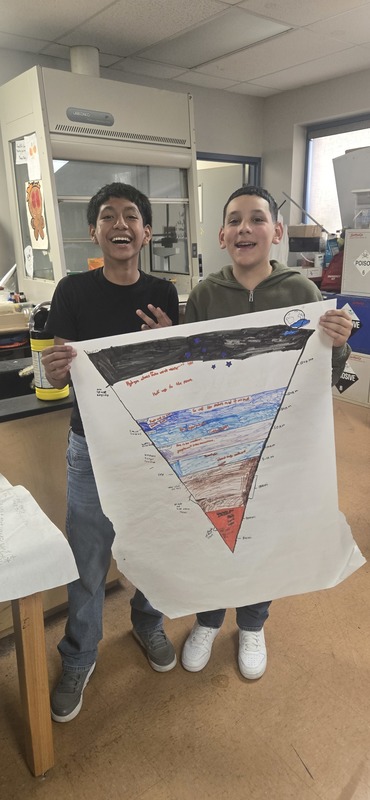

Exploring Earth from the Inside Out: Layers and Energy Transfer
The Sixth and Seventh grade science classes have spent the last few weeks studying how the energy flows through the layers of the Earth and the atmosphere and how that energy flow affects both the living and non-living factors in our environment. When we think about Earth, we often focus on what we can see—mountains, oceans, and skies. But beneath our feet and above our heads are complex layers that play a huge role in how energy moves through our planet. Understanding these layers helps explain everything from earthquakes to weather patterns.
The Layers of the Earth
Earth is made up of four main layers: the crust, mantle, outer core, and inner core.
The crust is the thin outer layer where we live. It includes continents and ocean floors and is broken into tectonic plates that slowly move over time. Beneath that is the mantle, a thick layer of hot, semi-solid rock. The mantle slowly flows, and this movement helps drive plate tectonics.
Deeper still is the outer core, made mostly of liquid iron and nickel. The movement of this molten metal generates Earth’s magnetic field. At the center is the inner core, a solid ball of iron and nickel that is extremely hot—almost as hot as the surface of the sun.
Energy inside the Earth moves mainly through conduction and convection. Conduction transfers heat through direct contact, while convection involves the movement of hotter, less dense material rising and cooler, denser material sinking. These convection currents in the mantle are what cause tectonic plates to shift.
The Layers of the Atmosphere
Above Earth’s surface, the atmosphere is divided into five main layers: the troposphere, stratosphere, mesosphere, thermosphere, and exosphere.
The troposphere is the lowest layer and where all weather occurs. Above it is the stratosphere, which contains the ozone layer that absorbs harmful ultraviolet radiation from the sun. The mesosphere is where meteors burn up as they enter Earth’s atmosphere.
Next is the thermosphere, a layer with very high temperatures caused by the absorption of solar energy. This is also where the northern and southern lights occur. The outermost layer, the exosphere, gradually fades into space.
Energy in the atmosphere is transferred through radiation, conduction, and convection. The sun provides energy through radiation, which heats Earth’s surface. That heat is then transferred to the air by conduction, and convection currents in the atmosphere create winds and weather systems.
Why It All Matters
The interaction between Earth’s layers and the atmosphere is what makes life possible. Energy flowing from the sun and from Earth’s interior drives weather, ocean currents, and even the movement of continents. Without these processes, Earth would be a very different—and likely uninhabitable—planet.
By understanding how energy moves through these layers, we gain a better picture of how our planet works as a connected system. From the deepest core to the edge of space, everything is linked by the constant flow of energy.